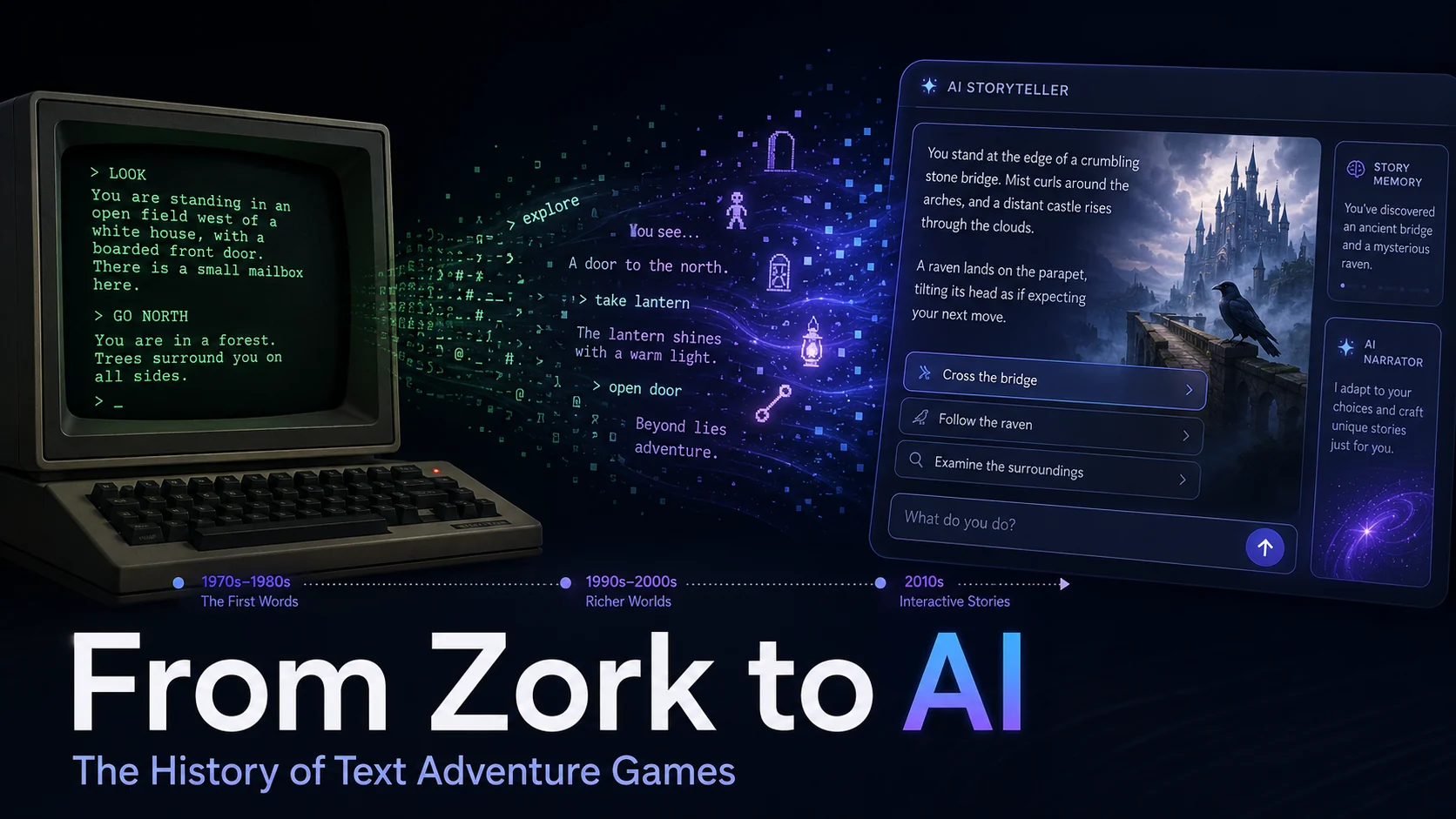
Fifty years ago, a story asked its reader a question for the first time: What do you want to do?
Everything about modern interactive storytelling, from choose-your-own-adventure books to AI stories that respond to anything you type, descends from that question. This is the history of text adventure games: how they were born in a cave, conquered early computing, died in public, survived in secret, and came back with an AI on the other side of the screen.
1976: a real cave and a broken family
The first text adventure game wasn't written by a game designer. Will Crowther was a programmer at BBN (the company building the early internet) and a caver who had helped map Kentucky's Mammoth Cave system. After his divorce, wanting something to share with his daughters, he wrote a program that let you explore a cave by typing simple commands: GO NORTH, TAKE LAMP.
He called it Adventure, later known as Colossal Cave Adventure. In 1977, a Stanford programmer named Don Woods found it on the ARPANET, got Crowther's blessing, and expanded it with fantasy elements. It spread from mainframe to mainframe, and legend has it that computing productivity across America dipped for weeks as programmers mapped the cave.
The core loop it invented is the same one you use in an AI story today: the game describes a situation, you type an action in words, the world responds.
1977 to 1979: MIT builds a smarter dungeon
At MIT's Dynamic Modelling Group, a handful of hackers played Adventure, finished it, and decided they could do better. Between 1977 and 1979, Tim Anderson, Marc Blank, Bruce Daniels, and Dave Lebling built Zork on a mainframe, and its great leap was the parser: where Adventure understood two words at a time, Zork could handle sentences like PUT THE LAMP AND THE SWORD IN THE CASE.
That parser mattered more than the dungeon. It was the first serious attempt at the promise that still drives the genre: describe what you want to do in something like natural language, and the world will understand you. Zork also gave the genre its most famous warning, the grue, a monster that eats players who wander in the dark, invented precisely so the game wouldn't have to describe unlit rooms.
1980 to 1989: the Infocom golden age
The Zork team founded Infocom in 1979, and in 1980 Zork I shipped for personal computers. It became one of the best-selling computer games of the early 1980s, and Infocom followed with a run that defined the medium: the Zork sequels, Enchanter, Planetfall (whose robot sidekick Floyd is often cited as the first game character players genuinely grieved), the detective classic Deadline, and in 1984 The Hitchhiker's Guide to the Galaxy, co-written by Douglas Adams himself.
Infocom marketed its games as "interactive fiction" and famously boasted about running on the best graphics hardware available: the human imagination. For a few years, that wasn't a cope. It was true, and the games were mainstream hits.
Then graphics got good. By the late 1980s, adventure games with pictures (King's Quest, Monkey Island's ancestors) were eating the market, Infocom stumbled through a disastrous business software venture, was bought by Activision in 1986, and was effectively shut down by 1989. Commercially, the text adventure was dead.
1990 to 2010: the underground years
Except it wasn't dead. It just stopped being a product and became a craft.
Free tools like TADS and Graham Nelson's Inform (1993) let anyone write parser games as good as Infocom's, and a community formed around Usenet groups to share them. In 1995 the annual Interactive Fiction Competition (IF Comp) launched, and it has run every year since. The underground era produced some of the most acclaimed works in the genre's history: Photopia, Spider and Web, Anchorhead, Galatea, works that treated the parser as a literary form rather than a puzzle box.
Meanwhile the choice-based branch of the family tree grew in parallel. Choose Your Own Adventure books had sold hundreds of millions of copies since 1979, and in the 2000s and 2010s their digital descendants arrived: Choice of Games' text novels, the free tool Twine (2009) that turned interactive fiction into an indie art movement, and polished commercial hybrids like 80 Days (2014). These games swapped the parser's freedom for authored, guaranteed-coherent branches. You could do less, but everything you did was written by a human.
That was the genre's fundamental trade-off for forty years: parser games offered freedom that constantly hit the wall of I DON'T UNDERSTAND THAT, and choice games offered polish inside a fixed menu. Pick one.
2019: AI Dungeon breaks the wall
In 2019, a BYU student named Nick Walton hooked a text adventure interface to GPT-2, one of the first large language models capable of extended coherent text. He called it AI Dungeon, and it did something no parser in forty years could do: it understood everything.
Type anything, in any words, and the story continued. Attack the dragon with a sandwich. Convince the villain to open a bakery. Nothing hit the wall. AI Dungeon went viral, and the fifty-year-old promise of Crowther's cave was suddenly, messily real.
Messily is the word, though. Early AI stories had no memory beyond a few pages, no plot, no stakes, and no consistency. The dragon you killed came back. Your name changed. The story went everywhere and arrived nowhere. The genre had traded the parser's wall for a new problem: infinite freedom with no structure.
2020s: from text generator to game master
The current era of AI story games is defined by attacking exactly that problem. The underlying models improved enormously, and platforms grew layers around them: memory systems so earlier choices still matter later, scenario structure so stories start somewhere and go somewhere, and mechanics borrowed from tabletop RPGs so actions can fail and stakes can exist.
The result is a whole ecosystem where AI Dungeon once stood alone: tabletop-style platforms with rules and dice, writing tools, character chat apps, and interactive story platforms across every genre from horror to cultivation to cozy slice-of-life. We compared the major ones in our guide to the best AI Dungeon alternatives, and the differences between them are basically different answers to the same old question: how much freedom, how much structure?
What's genuinely new is the community layer. In the Infocom era, writing a text adventure required programming. In the Twine era, it required design and writing. Today, on platforms like Questner, a player can build a world, publish it, and have thousands of other players type their way through it. The medium that started as one father's gift to his daughters has become something closer to a folk art: everyone can tell a story that answers back.
The one unbroken thread
Strip away fifty years of technology and the genre has changed less than it seems. Adventure in 1976, Zork in 1980, Anchorhead in 1998, AI Dungeon in 2019, and whatever you play tonight all run on the same loop:
The world describes itself. You say what you do. The world responds.
The only thing that has ever changed is how well the other side listens. In 1976 it understood two words. Today it understands anything you can type. What you say to it has always been up to you.
If you've never tried the modern version, start a story on Questner and type something no parser would ever have understood. That's fifty years of history answering you back.